
Woodland Park Form Routing
The nontraffic form and accident form serve different records. A requester seeking a theft, disturbance, arrest narrative, welfare check, or other non-crash incident should begin with the online nontraffic form. A collision belongs on the separate traffic accident request. This split is more than a label. It sends the request toward staff and records organized for the right event type, which can prevent delay and avoid a second submission.
Before opening either form, gather the WPPD report number if available, the incident date and time, the Woodland Park location, and the names connected to the event. The nontraffic form permits victim and suspect names and dates of birth, officer names, and added details. It also asks how the record should be delivered. Pickup may help when an original certification or payment exchange is needed. Email can be faster for an ordinary electronic copy. Mail requires a complete delivery address and time for postage.
The signed affirmation deserves a careful read. It addresses commercial solicitation based on criminal-justice records and pay-to-remove booking-image practices. The certification does not expand public access, and it does not mean WPPD has a booking photograph for every incident. Woodland Park has no city jail. When a custodial arrest occurs, the sheriff controls the county intake record while WPPD controls its own report. Ask each custodian only for the product it holds.
Preparing a Woodland Park Court Request
Because Woodland Park publishes no full municipal case-search portal, a well-prepared clerk request saves time. Read the ticket for the city court name, citation number, defendant spelling, alleged violation, and appearance date. Then state the exact product needed, such as a register of actions, disposition, judgment, or certified copy. A request for “everything” can require clarification and may include material that is restricted or irrelevant.
Confirm whether the file is municipal before discussing payment. DUI, driver-license, registration, and plate matters route to Teller Combined Court even when WPPD issued the citation. The city clerk cannot certify that county file. If the summons names Woodland Park Municipal Court, call 719-687-5207 or use the published clerk email. Confirm current hours and whether the record can be sent electronically, collected at City Hall, or must be mailed.
How to Check Criminal History in Woodland Park
Start with the office that made the record. Woodland Park Police Department, or WPPD, is the custodian for its incident and arrest reports. Woodland Park Municipal Court holds city charter, ordinance, animal citation, and qualifying traffic or criminal files. Teller County Combined Court handles state cases, including DUI and driver-license, registration, or plate matters. The sheriff maintains county bookings. CBI supplies the Colorado-wide criminal history product.
A careful search follows the event through those layers. Names alone can produce false matches, so use a date of birth and report or case number when the official form permits them.
- Identify whether WPPD, the sheriff, or another agency handled the incident.
- Submit the correct WPPD nontraffic or traffic-accident request.
- Read the summons header and contact the court named there.
- Check Teller County custody and court channels for a booking or state charge.
- Use CBI ICHC for a broader Colorado name-based history.
Woodland Park Police Request Forms
WPPD separates nontraffic police reports from traffic accident reports. That distinction matters. A crash request sent through the general nontraffic form can delay routing, while an incident, theft, disturbance, or arrest narrative belongs on the nontraffic form. The records landing page links both products.
The online nontraffic form asks for the requester name, report number, incident date, time, location, city, state, and ZIP. It also accepts victim and suspect names and dates of birth, involved officers, and added details. The requester selects pickup, mail, or email, supplies a required phone number, and signs and dates the request. An email-copy checkbox and an anti-monetization affirmation are part of the form. Be precise, but do not add sensitive identifiers the request does not need.
The official Woodland Park nontraffic request form shows the fields and certification used for this record channel.
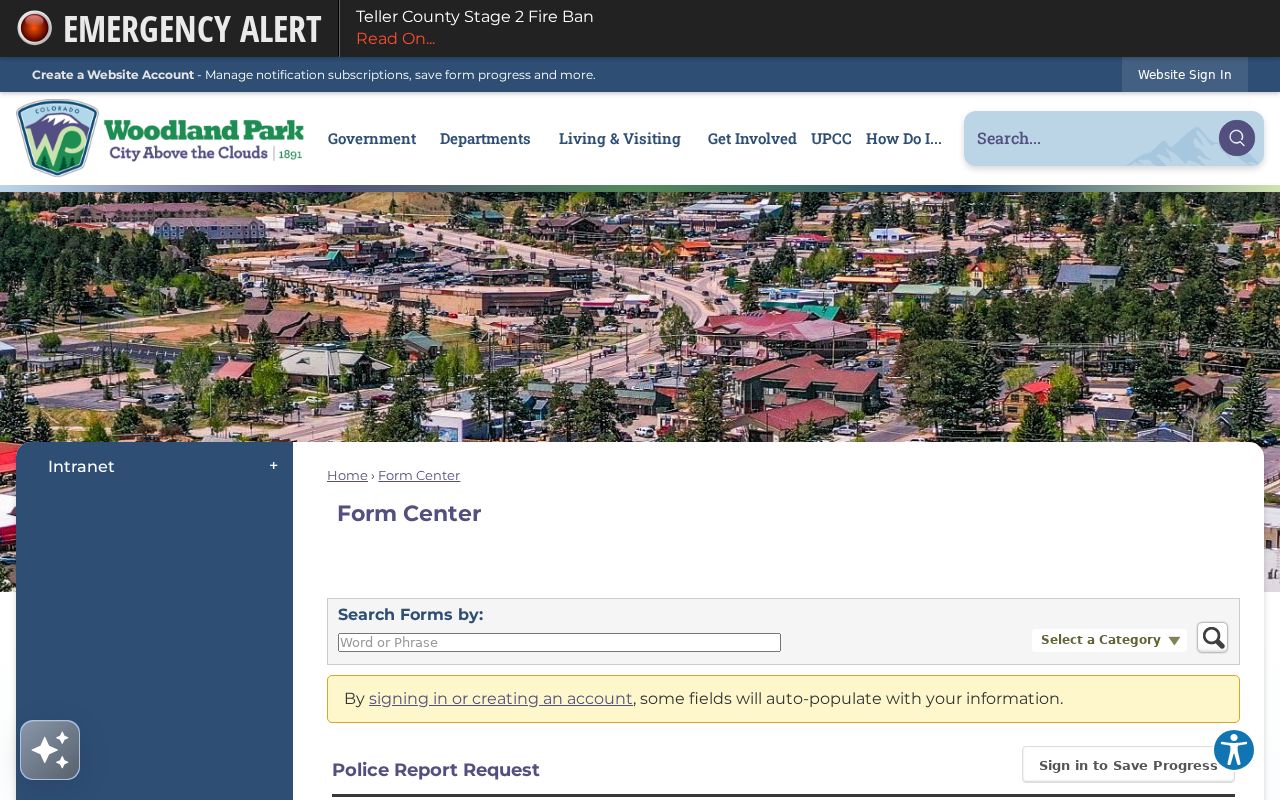
That form belongs to WPPD reports; a traffic crash uses the separate city PDF request.
The Woodland Park Police Department
WPPD is at 911 Tamarac Parkway, Woodland Park, CO 80863. Mail may be sent to P.O. Box 7255, Woodland Park, CO 80866. The records telephone is 719-687-9262 and the fax is 719-687-1869. Its files can include incident narratives, officer reports, arrest details, and releasable attachments created by the department. WPPD does not hold the municipal court's official judgment or the sheriff's booking file.
The nontraffic request has a $10 minimum. Requests longer than ten pages may add $0.25 per page. WPPD accepts a money order or personal check and says not to send cash. The form's certification addresses use of criminal-justice data to solicit business and pay-to-remove booking-image publication. That language reflects Colorado restrictions, not a promise that a photo or every attachment will be released.
Woodland Park Summons Venue
Location does not decide the court. Woodland Park Municipal Court hears city charter and ordinance cases plus qualifying traffic and criminal violations. Animal citations are treated as criminal matters there. DUI allegations and driver-license, vehicle-registration, and plate matters route to Teller County Combined Court. WPPD can therefore create the police record while a different court keeps the prosecution record.
Inspect the summons caption before calling. It should name the court and give a case or citation number. A municipal clerk can answer questions about a city docket but cannot produce a county-court file. Likewise, the Combined Court cannot substitute for WPPD's narrative report. Matching the police number to the court number helps prevent two related identifiers from being mistaken for separate events.
Arrests and Bookings in Woodland Park
Woodland Park advertises no city jail. When WPPD makes a custodial arrest, the person is normally taken to the Teller County detention operation in Divide. WPPD retains its incident and arrest report. The sheriff creates the intake and custody record. A citation or summons can proceed without any booking, so a missing jail result does not erase the police contact or municipal case.
For current custody, use the sheriff's inmate-search route or call 719-687-7770. Gather the person's first, last, and any hyphenated names, aliases, date of birth, and country of birth before calling. A negative result may mean release, transfer, a spelling difference, detention elsewhere, or a cite-and-release event. Continue with WPPD and the court named on the summons rather than treating the roster as a full history.
Woodland Park Court Calendar
Municipal Court sessions are scheduled on the second and fourth Wednesday, with juvenile matters on the fourth Wednesday. The office is generally open Tuesday through Thursday from 8 a.m. to 5 p.m. at City Hall, 220 W. South Avenue. Contact the clerk at 719-687-5207 or kcollins@woodlandpark.gov before travel. The court says its staffing and technology do not support full-time remote observation.
A missed appearance can lead to a bench warrant. A not-guilty case may move to trial within 91 days, and a jury request must be written within 21 days with a $25 jury fee. Payments on or after the court date can add $20 in court costs. Those rules concern municipal cases; the Combined Court follows its own calendar and procedures.
Woodland Park Municipal Court Records
No public online municipal case portal was identified. Use the clerk's telephone, email, or counter to ask for the docket, disposition, order, or copy that is public. Supply the defendant's correct spelling, citation or case number, and a useful date range. Ask for a fee estimate and whether certification is available before sending payment.
| Court Name | Woodland Park Municipal Court, City Hall, 220 W. South Avenue |
|---|---|
| Case Types Heard | Charter and ordinance cases, animal citations, and qualifying traffic and criminal violations |
| Case Lookup Channel | Clerk by phone, email, or counter; no public portal identified |
| What the Docket Shows | Case identifier, allegations, settings, pleas, orders, outcome, and payment status as public |
| Copies & Fees | Ask the clerk for current copy and certification charges |
Where Woodland Park Records End Up
A city event can leave several records. WPPD creates the narrative and arrest paperwork. A custodial intake creates a Teller County jail record. A municipal allegation stays with the city court, while a state offense proceeds through Teller County Court or District Court. Fingerprint-supported arrest and reported disposition data can later reach the Colorado Bureau of Investigation.
Record flow: Woodland Park Police Department › Teller County Courts › Colorado Bureau of Investigation
The sequence is not instant. Recent activity may appear first at WPPD or the jail. The court file is the better source for filed charges and final outcomes. CBI ICHC is Colorado-only and name-based; its $6 downloaded result is not the underlying report, a certified docket, or a national FBI check. Use the Teller County criminal history overview for deeper county and state routes.
Woodland Park Custodian Boundaries
The city clerk, police records staff, municipal court clerk, county sheriff, and Combined Court are distinct custodians. A request for city council material does not reach a WPPD report. A police form does not order the municipal disposition. The county jail can confirm custody but cannot certify what the city judge decided.
Describe an existing record rather than asking an office to research a person or explain events. Include a report or citation number, date range, location, parties, and the exact item wanted. For video, audio, or a large set of records, ask about review and redaction costs in advance. Each custodian may protect victim, juvenile, medical, personal-identifier, security, or active-investigation information.
Woodland Park Record Geography
Woodland Park's “City Above the Clouds” identity grew along the Ute Pass route and the arrival of the Midland Railroad in 1888. Today it is Teller County's largest incorporated city, yet the county courthouse and many prosecution records sit in Cripple Creek. The sheriff and jail are in Divide. That mountain geography explains why one local incident can require contacts in three communities.
Confirm hours and operating conditions before setting out, especially during severe weather. Electronic requests can reduce a needless trip. When an original or certified product matters, ask the custodian whether pickup, mail, or email meets the need. A screen result or emailed lead may help locate a file, but it is not always the official certified record.
Tracing Older Woodland Park Cases
For an older event, begin with any citation, receipt, or case number already available. WPPD can locate its own report, while the correct court can find the register of actions and disposition. If the matter was a state prosecution, the Teller County Combined Court is the source. CBI ICHC may connect fingerprint-linked arrest cycles with dispositions that were reported later, but missing data should be checked against the court file.
Do not infer conviction from an arrest or intake charge. Prosecutors can amend or dismiss counts, and a case can end in acquittal, deferred judgment, or another result. Read each count's outcome. Sealed matters and protected records will not be available like ordinary public files.
Public Access Rules
Colorado criminal-justice records are generally handled under CCJRA, while other city administrative records fall under CORA. Release is not all or nothing. A custodian may redact protected identifiers or withhold active investigative, victim, juvenile, medical, or security-sensitive material. Colorado court access also follows Chief Justice Directive 05-01, which assigns public, protected, restricted, suppressed, or sealed access levels.
Key Statutes:
Colorado Criminal Justice Records Act, C.R.S. §§ 24-72-301 through 24-72-309 governs access to police and other criminal-justice records.
Colorado Open Records Act, C.R.S. §§ 24-72-200.1 through 24-72-206 governs many non-criminal city records.
Chief Justice Directive 05-01 sets Colorado court-record access classifications.