
Criminal Cases in the Teller County Courts
Teller County criminal court cases filed under state law are handled at the Teller County Combined Court. District Court handles felonies. County Court hears state misdemeanors and traffic cases and conducts the first stages of felony complaints. Both court levels operate at the historic courthouse in Cripple Creek, but their jurisdiction is not the same. A local case number commonly uses the filing year, the class code, and a sequence, such as YYYYCRsequence.
The Teller County judicial Clerk of Court keeps pleadings, orders, the register of actions, and certified case records. That office is distinct from the elected Teller County Clerk and Recorder, which handles property, election, marriage, and county-board records. Municipal ordinance cases remain with the Woodland Park, Cripple Creek, or Victor municipal clerk. Read the summons heading before choosing a counter, since the place of an incident alone does not identify the court.
Teller County Criminal Court Counter
The Combined Court is at 101 W. Bennett Avenue, P.O. Box 997, Cripple Creek, CO 80813. Clerk Sheila Griffin's office can be reached at 719-689-7360. Court assignments can change, so use the current staff directory rather than relying on an old order. The official judges and staff page is the best source for a current division contact.
The official Teller County trial-court page also carries closure and remote-hearing notices. Confirm conditions before a mountain trip. Visitors should expect security screening, and requests for language access, accommodation, or assistive listening should go to the court in advance. Parking, device use, and permission to photograph a file were not confirmed in the official material, so ask the clerk before relying on any of those options.
Teller County Combined Court
101 W. Bennett Avenue
Cripple Creek, CO 80813
719-689-7360
District and County Court criminal files
The official Teller trial-court page shows the court's public access point.
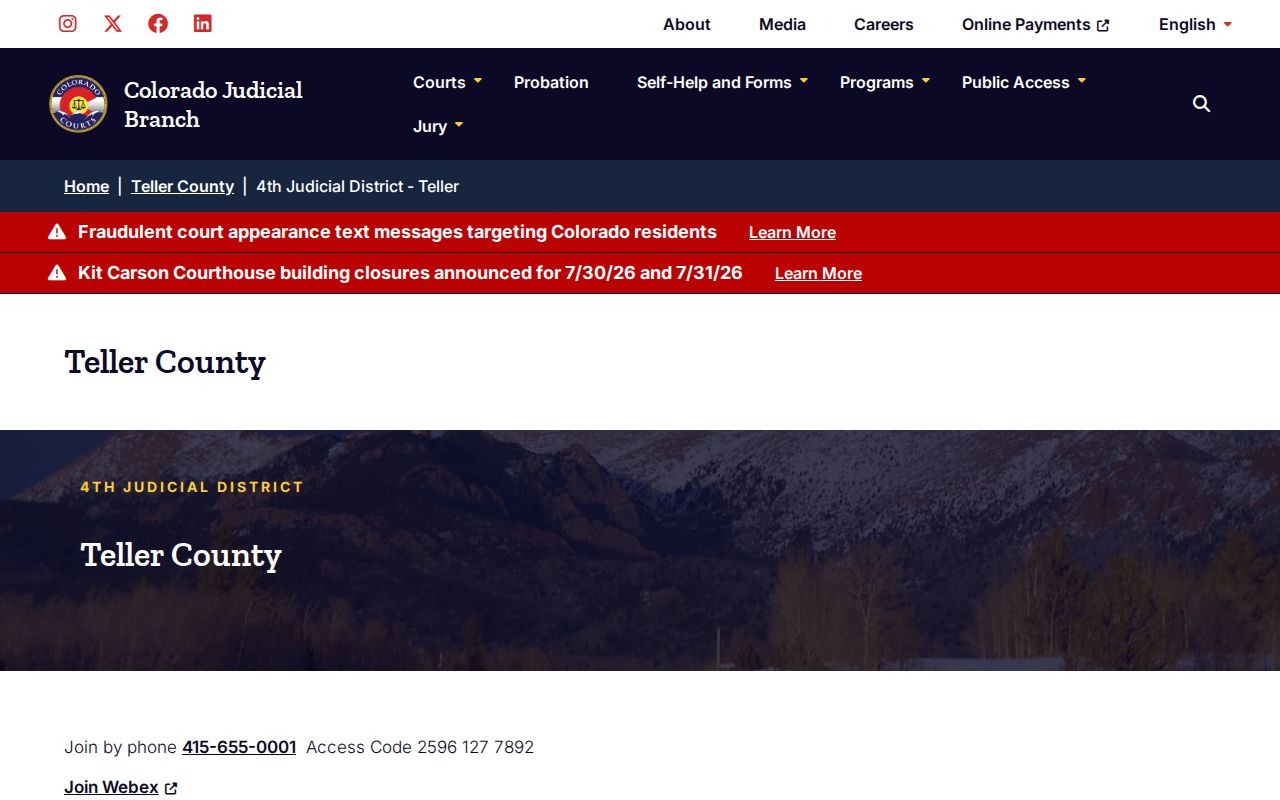
Use that source to verify courthouse notices before requesting a Teller County criminal case record.
How to Search Case Records
Colorado Judicial does not provide free document images through an ordinary statewide name portal. Commercial services may show real-time register-of-actions data from the Judicial database, but those results are locator tools, not the official Teller County criminal case file. The most reliable path pairs a name or case-number lead with a direct document request to the Teller clerk.
- Decide whether the citation or complaint belongs to District Court, County Court, or a municipal court.
- Use the full party name or complete case number to locate the right Teller County criminal case.
- Match the filing year and case class. Use date of birth only through a channel that lawfully requests it.
- Read the register of actions count by count, noting filed charges, hearings, rulings, and the final disposition.
- Submit the official Judicial Record/Document Request Form to obtain the ROA, order, pleading, or certified copy.
| Field Label | Type | Required | Notes |
|---|---|---|---|
| Last Name | Text | Conditional | Use the full legal surname and known variants. |
| First Name | Text | Conditional | Add the full given name to reduce false matches. |
| Case Number | Text | Conditional | Best identifier when the complete number is known. |
| Date of Birth | Date | Channel-specific | Use only when the authorized search or request asks for it. |
| Case Type / Year | Text or select | Recommended | Match the year and CR case class. |
Teller Criminal Case Record Products
Choose the Teller County record product that answers the question. A register of actions, often called an ROA, is the compact chronology. A Complaint or Information states the charge filed by the prosecution. A Disposition or Sentence Order is stronger proof of the final outcome and court-ordered terms. A ticket may be the key document in a traffic or lower-level case, while a Protection Order can have restricted personal details.
The Colorado Judicial Record/Document Request Form routes requests for these official items. Published charges include $0.25 for a single-sided page, $0.50 for a double-sided page, $20 for certification, $1 per faxed page, and $35 for tape or CD transcript duplication. Search or retrieval charges vary. Ask for an estimate when the file is long or stored off-site.
| Record Service | Published Amount |
|---|---|
| Single-sided copy | $0.25 per page |
| Double-sided copy | $0.50 per page |
| Certified copy | $20 certification fee |
| Fax copy | $1 per page |
| Tape or CD transcript duplication | $35 |
The official request page displays the form and current court guidance.
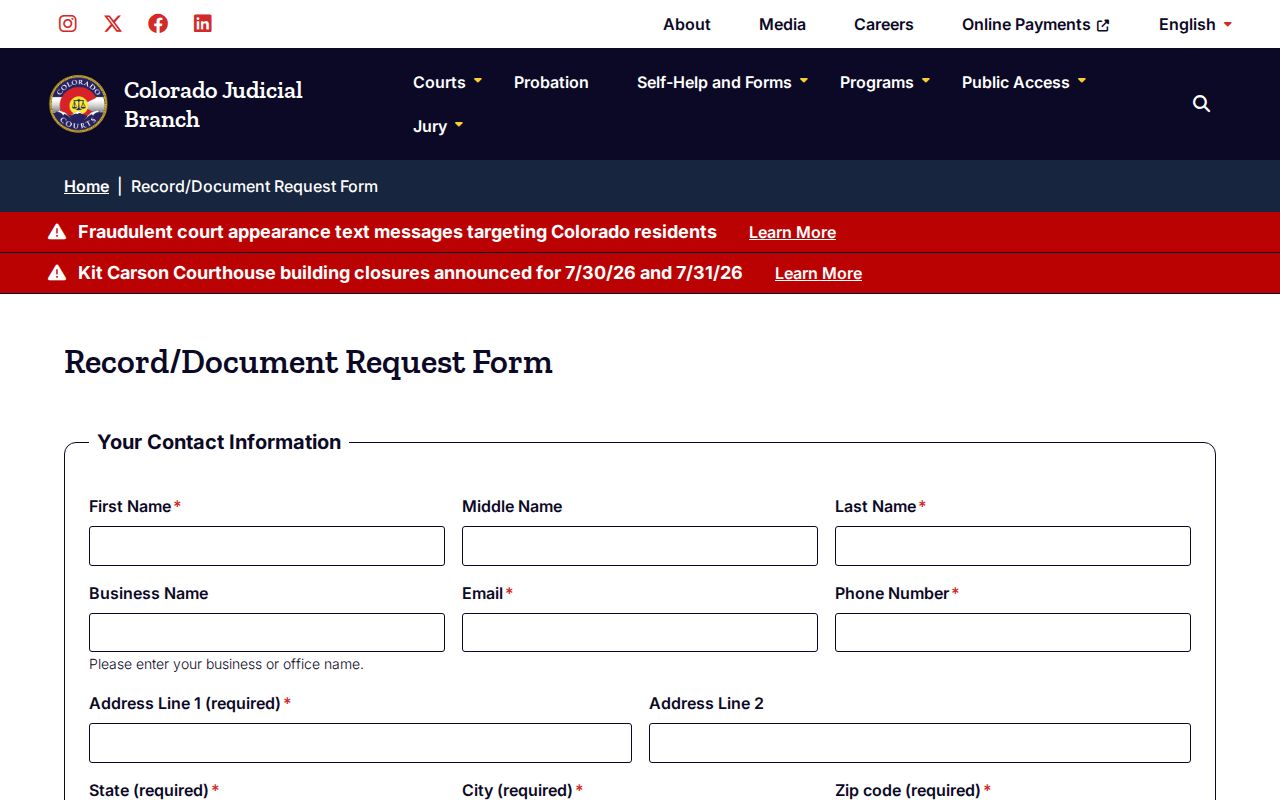
Certification is a separate act by the court, not a feature of a vendor search result.
What the Case File Shows
A Teller County criminal case file is organized around one prosecution. It can contain the charge as filed, chronological minute entries, hearing dates, motions, rulings, plea or trial result, judgment, and sentence. A public order may also show the court address, People of Colorado caption, division, courtroom, document title, filed date and time, judicial signature, statutory notices, and the next appearance. Some attachments remain protected even when the docket entry is public.
| Case Number & Court | Identifies filing year, case class, sequence, court level, and division. |
|---|---|
| Charging Document | Complaint, Information, indictment, or ticket stating the filed allegations. |
| Docket Entries | Chronological record of filings, appearances, motions, and rulings. |
| Hearing Dates | Past events and any scheduled next appearance, with location when stated. |
| Disposition & Judgment | Outcome for each charge, such as dismissal, deferred judgment, acquittal, or conviction. |
| Sentence & Conditions | Court-ordered custody, probation, restitution, or other terms after conviction. |
Read Teller Criminal Case Numbers
A Teller County number in the form YYYYCRsequence gives three useful clues. The first four digits are the filing year. The letters identify the criminal case class. The final sequence distinguishes that filing from other cases opened in the same class and year. Keep all parts together when calling the Teller County criminal court clerk or filing a records request.
Then read outcomes by charge count. One count may be dismissed while another ends in a plea or verdict. Charges can also change after booking. The arresting officer's intake label is not proof of what the prosecutor filed, and neither label alone establishes a conviction. The ROA and signed disposition order provide the clearest path from allegation to result.
- Register of actions
- The chronological docket of filings, hearings, charges, and results.
- Disposition
- The procedural outcome of a charge, such as dismissal, acquittal, or conviction.
- Deferred judgment
- A guilty plea with judgment delayed while court terms are completed.
- Mittimus
- The court's formal direction committing a sentenced person to custody.
Stages of a Criminal Case
A Teller County criminal case may begin with an arrest or citation, followed by advisement and a release decision. A complaint starts lower-court processing. Felony matters can proceed by Information or indictment into District Court. Arraignment records the plea. Pretrial motions and negotiation follow, unless the matter resolves sooner. A dismissal, deferred judgment, guilty plea, trial acquittal, or trial conviction supplies the disposition. A conviction then leads to sentence and may lead to appeal.
Case flow: Charges Filed › Arraignment › Pretrial › Plea or Trial › Disposition › Sentencing
There is no single safe time estimate for every Teller County criminal court case. The charge level, motion practice, trial demand, and court calendar can alter the pace. Use dated docket entries instead of assuming that a case with no recent public update has ended.
Teller Criminal Case Docket
A real-time vendor docket can help identify the Teller County court and case number. It cannot issue a certified record and may not include filed document images. The official Teller County criminal case file remains with the Judicial Branch. When an exact outcome matters, obtain the ROA and the signed disposition or sentence order from the clerk.
Use the docket as a lead. Match the party, year, class, and sequence, then verify each charge outcome against an official court document.
The current Teller court directory identifies the clerk and division contacts.
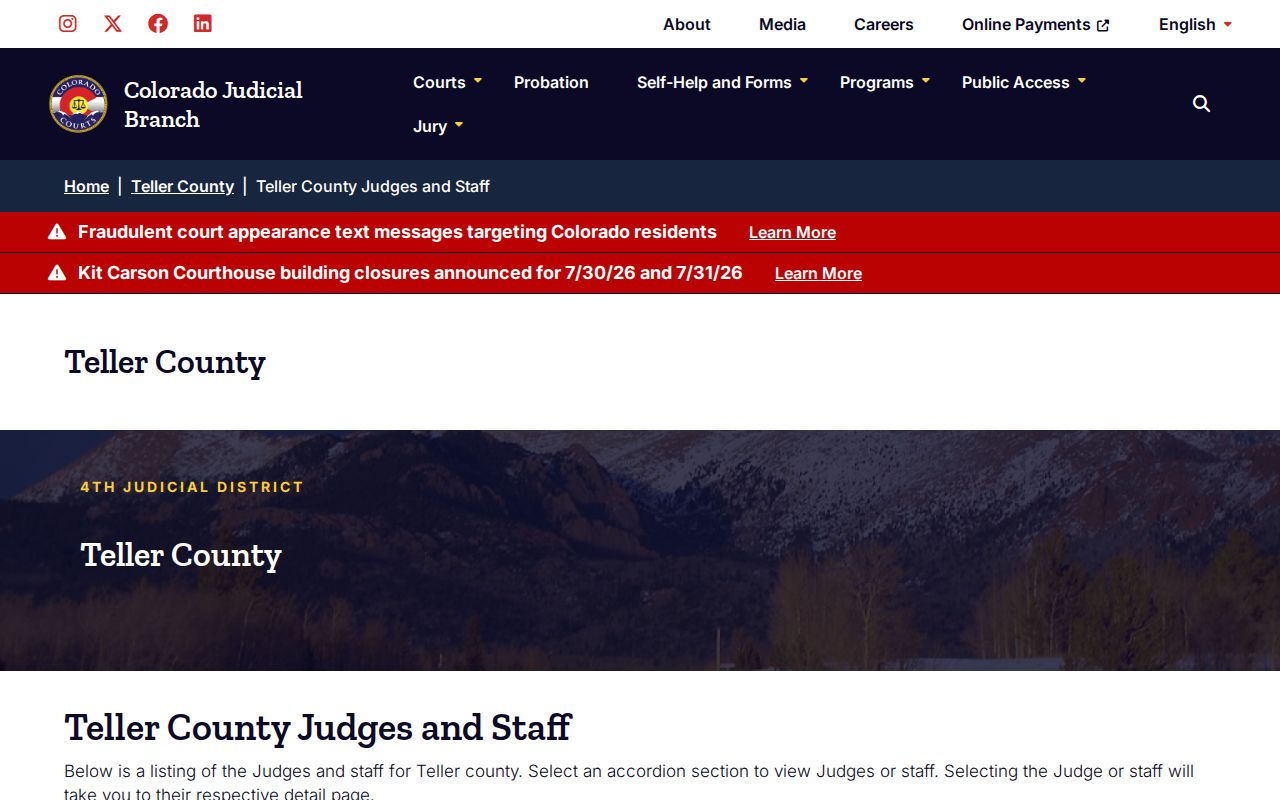
Check it before directing a request to a named judge or staff member because assignments may change.
Teller Criminal Cases by City
Not every Teller County citation reaches Combined Court. Woodland Park Municipal Court keeps city charter, ordinance, qualifying traffic, and criminal-violation files. DUI, driver-license, registration, and plate matters route to Teller Combined Court. Cripple Creek citations can also split between its municipal court and the Combined Court. Victor's clerk keeps municipal cases based on city ordinance summonses issued through the sheriff's contract service.
None of the three city courts had a verified public case-search portal in the research. Use the ticket header, then call or contact the correct municipal clerk. For a broader view of custody and police records, the Teller County arrest history page explains why an incident report, booking file, and court case may sit with different custodians.
Case Record Access and Restrictions
Colorado law makes official-action records open for inspection under C.R.S. § 24-72-303. Other criminal-justice records are subject to custodian review under §§ 24-72-304 and 24-72-305. Chief Justice Directive 05-01 classifies Judicial Branch records as Public, Protected, Restricted, Suppressed, or Sealed. A public docket line therefore does not make every attachment public.
Protected identifiers may be redacted from a Teller County file. Juvenile material, victim and minor information, some protection-order data, and sealed records may not appear in an ordinary Teller County criminal case search. If a known case is absent, give the clerk the full case number and ask whether a releasable ROA or order exists. Colorado's sealed-case verification tool is limited to the defendant and is not a public name search.
Adult Teller County relief is usually called record sealing in Colorado. Expungement applies mainly to juvenile and narrow specialized matters. A sealing order limits routine public access but does not guarantee destruction or remove all authorized agency access. The official directive index provides the controlling court-access framework.