
Reviewing a Cripple Creek Estimate
A cost estimate should identify the product, not just one total. Compare the page count, staff-review time, media format, postage, and deposit. The first staff hour is excluded before the $41.37 hourly charge, while the first five report pages use the separate $5 rate. Ask staff to explain which portion applies when a request combines a paper narrative with audio, video, or photographs.
If the estimate is higher than expected, narrow the date range or select one record type. That choice can preserve the most useful material without requiring a broad search. A revised scope should remain in writing so the final production can be checked against it.
Cripple Creek Request Specificity
Cripple Creek's policy expects a request that lets staff locate existing records without guessing. Name the record or title when known. Add the location, date range, subject, and likely author or recipient. For a police event, the case number is best. When it is missing, describe the incident, address, approximate time, and involved names. The web form gives space for that narrative and also collects a reply email and telephone number.
A custodian can ask for clarification when the scope is unclear. Respond promptly and keep a copy of the refined wording. An unclarified request can be abandoned. This does not require a requester to know the department's filing system, but it does require a practical description. “All records about a person” is much harder to process than a specified report, radio call, photograph set, or video tied to one event.
The same care helps with costs. A five-page report begins at $5, while audio, video, or an extensive search can require staff review at $41.37 per hour after the first staff hour. Ask the city to separate retrieval, redaction, copy, media, and postage amounts. If a deposit is required, confirm what work it authorizes. Once records are ready, retrieve and pay for them within ten business days to avoid abandonment under the policy.
Cripple Creek Inspection Workflow
Inspection is generally arranged Tuesday through Thursday from 8 a.m. to 4 p.m. It can be useful when a requester needs to identify a few pages from a larger public file. Staff keeps control of the originals, and requesters are not allowed to use city computers. Bring the request correspondence, the case or report number, and a way to note which pages should be copied.
Ask whether redaction will be completed before the appointment. Protected information does not become public merely because inspection is chosen instead of copies. Active investigative material, victim and juvenile details, personal identifiers, medical facts, and sensitive law-enforcement information can be removed or withheld. If the file includes radio or video, staff may need time to review the recording before access. The hourly media rate reflects that work.
Inspection at CCPD does not include the municipal docket or the sheriff's booking file. For a city-court outcome, contact the municipal clerk. For present or past county custody, use TCSO. Keeping these requests separate makes the source of each document clear and prevents the $5 CCPD report price from being mistakenly applied to another agency's product.
How to Check Criminal History in Cripple Creek
Cripple Creek Police Department, or CCPD, is the first stop for a report it created. Municipal Court handles code, ordinance, and qualifying traffic or criminal violations. Some CCPD citations go instead to Teller County Combined Court. The sheriff keeps the county booking record, while CBI maintains statewide fingerprint-supported history.
Use one known fact to find the next. A report number can lead to a citation, and the citation caption can lead to the right docket. Do not treat a booking allegation as a final charge.
- Confirm that CCPD, rather than the sheriff or state patrol, handled the event.
- Send CCPD a specific request for the report or releasable media.
- Read the ticket and contact the court named on it.
- Use Teller County channels for booking and state-court records.
- Check CBI ICHC when a broader Colorado history is needed.
Cripple Creek Web Request Details
CCPD's online request asks for the date, case number, an incident narrative when the number is unknown, and the requester's name, email, and phone. It also asks for the reason, typed signature, date, and reCAPTCHA submission. A useful narrative states what happened, where, and within what date range without asking the department to create an analysis.
The detailed policy calls for specificity by record name or title, location, dates, authors or recipients, and subject. Staff may seek clarification. If the requester does not clarify, the request can be treated as abandoned. Available records that are not retrieved or paid for within ten business days are also abandoned, so watch for estimates and ready notices.
The official Cripple Creek Police records request displays the city's direct submission route.
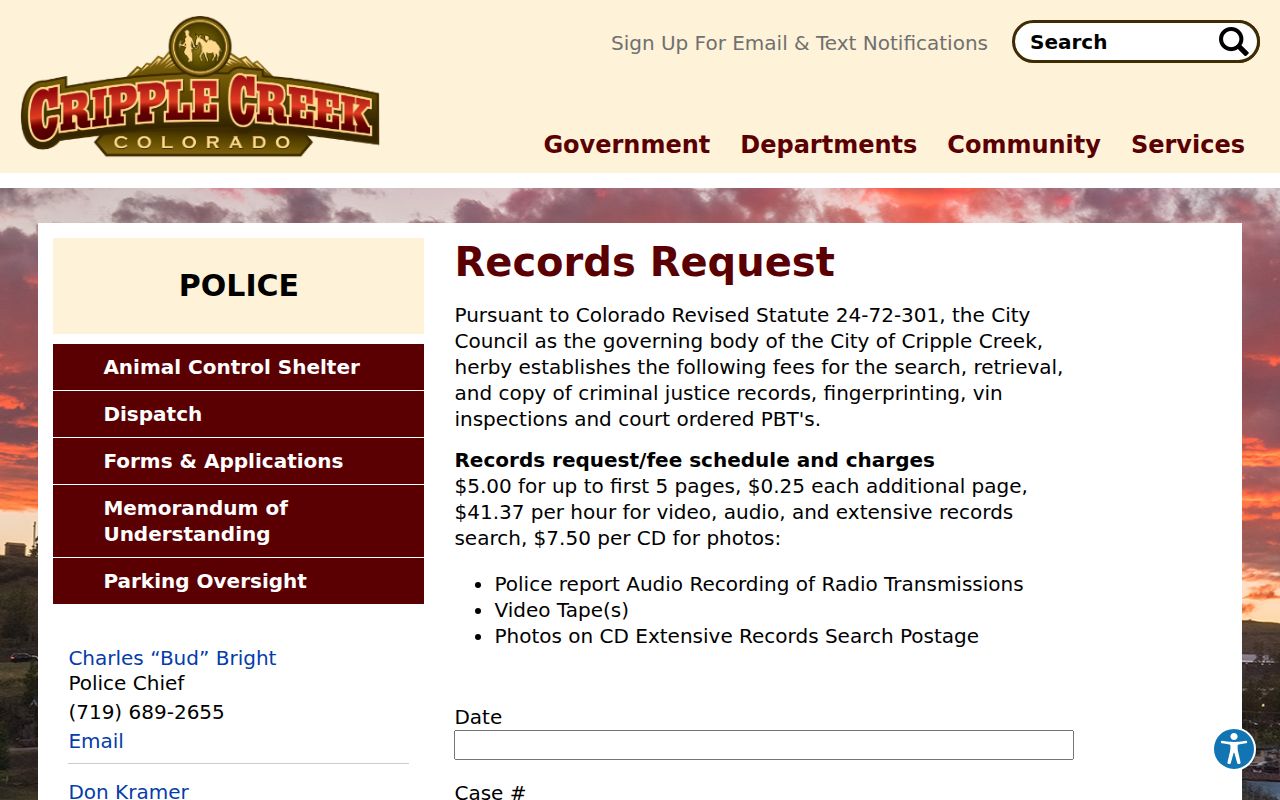
Its city-specific fields should not be used to request a TCSO or Woodland Park record.
The Cripple Creek Police Department
CCPD is at 337 E. Bennett Avenue, Cripple Creek, CO 80813. The telephone is 719-689-2655 and fax is 719-689-3248. It keeps its incident, investigation, arrest, and related law-enforcement records. It does not hold the official Municipal Court judgment, a Teller County jail intake file, or a CBI rap sheet.
Inspection appointments are generally offered Tuesday through Thursday from 8 a.m. to 4 p.m. Requesters do not receive access to city computers. The custodian retains control of original records and may supply copies. Active investigations, protected identities, juvenile or victim data, medical material, and security-sensitive information can be withheld or redacted under Colorado law.
Cripple Creek Report and Media Costs
CCPD distinguishes a short paper report from time-based media. The first five report pages, including retrieval, cost $5. Added pages are $0.25 each. Standard black-and-white copies are $0.25 per side and color copies are $0.50 per side. Photos were listed at $7.50 per CD, with actual postage added when needed.
Radio audio, video, and extensive searches can cost $41.37 per hour because staff must locate, review, and redact the material. The first staff hour is excluded before that hourly charge. A deposit can be required. Ask for an estimate that separates paper, media review, copies, and delivery. Do not assume a five-page report fee includes body-camera video, radio traffic, photographs, or a broad records search.
| Product | Published amount |
|---|---|
| First five report pages with retrieval | $5 |
| Added report pages | $0.25 per page |
| Radio, video, or extensive search | $41.37 per hour after first staff hour |
| Photo CD | $7.50 |
| Color copy | $0.50 per side |
Arrests and Bookings in Cripple Creek
CCPD has no published city jail roster. A custodial arrest routes to the Teller County detention facility in Divide, where the sheriff creates the booking record. CCPD still owns the police narrative. A summons can create a municipal or county case without a jail admission, so searching custody alone misses cite-and-release events.
Use the sheriff's inmate-search route or call 719-687-7770 for current custody. Have first, last, and hyphenated names, aliases, date of birth, and country of birth ready. Release, transfer, spelling, another holding county, or a summons without booking can explain a negative result. For filed charges and the outcome, check the court named on the citation.
Cripple Creek Weather Calendar
Municipal Court is scheduled for the second Wednesday of each month at 10 a.m., weather permitting, in the City Hall council chambers. The phrase “weather permitting” has practical weight in a mountain city. Confirm the session before travel, especially during winter or severe weather.
The clerk's office is generally open Monday through Friday from 8 a.m. to 4 p.m. Call 719-689-2502 or email mmykol@cripple-creek.co.us. No public online case lookup was identified. A phone, email, or counter request should include the case or citation number, defendant spelling, and a narrow date range. Ask whether a setting changed and whether the desired copy is public.
Cripple Creek Municipal Court Records
The court hears city code and ordinance matters plus qualifying traffic and criminal violations. CCPD can also cite a matter to Teller Combined Court, so the ticket controls. Municipal records can show the allegation, settings, plea, orders, judgment, and payment information that is public. County state-case records remain with the Colorado Judicial Branch clerk.
| Court Name | Cripple Creek Municipal Court in City Hall council chambers |
|---|---|
| Case Types Heard | City code and ordinance matters, qualifying traffic and criminal violations |
| Case Lookup Channel | Municipal clerk by phone, email, or counter; no public portal identified |
| What the Docket Shows | Case number, allegations, settings, pleas, orders, outcome, and public payment entries |
| Copies & Fees | Request a current estimate from the municipal clerk |
Reading a Cripple Creek Ticket
Do not choose the court because the stop occurred within city limits. Read the summons heading, return address, court name, and appearance instructions. A city ordinance allegation normally stays municipal. A state charge may move to Teller County Court or District Court. One police contact can therefore generate a CCPD report and a Colorado Judicial Branch case.
If the ticket is unavailable, give CCPD the event date, place, parties, and report number, then ask which court received the citation. Court staff can confirm their own case but should not be asked to reconstruct the police investigation. Keep the report and court identifiers together because they may use different numbering systems.
Where Cripple Creek Records End Up
CCPD reports begin at the city department. Custodial arrests add a sheriff booking in Divide. City-code matters proceed in Municipal Court, while state charges go through the Teller Combined Court. Fingerprints and reported court outcomes can later become part of Colorado CHRI maintained by CBI.
Record flow: Cripple Creek Police Department › Teller County Courts › Colorado Bureau of Investigation
Timing differs at each step. CCPD may have the newest narrative. The jail shows current custody, not every arrest. A court register of actions is the better source for filed counts and disposition. ICHC is a $6 Colorado-only name search, not a certified docket or national check. See Teller County criminal court cases for the county process.
East Bennett Record Setting
Cripple Creek is both Teller County's seat and a historic mining and casino city. The courthouse, City Hall, and CCPD may be close in distance, but proximity does not merge their files. The elected County Clerk and Recorder also works at the courthouse but handles property, elections, marriage, and county-board material, not criminal case files.
Ask for the judicial Clerk of Court when seeking a state prosecution. Ask the city municipal clerk for a city docket. Ask CCPD for its law-enforcement report. This small distinction prevents a common wrong-counter trip and keeps a request under the right access rules.
From Cripple Creek Custody to Outcome
A booking charge records the reason for intake. It can differ from the count a prosecutor files, and either can differ from the final judgment. Charges may be amended or dismissed. A case can end by plea, trial, acquittal, deferred judgment, or another disposition. Match each count to its outcome rather than treating one case label as the result of all counts.
Older fingerprint-supported cycles may appear in CBI CHRI after dispositions are reported. Missing or incorrect disposition data should be checked against the official court record, then corrected through the appropriate court or CBI process. Sealed records and protected attachments are not ordinary public material.
Public Access Rules
CCJRA governs police and other criminal-justice records. CORA covers many city administrative files. Chief Justice Directive 05-01 governs access classifications for Colorado court records. A public docket entry does not mean every attachment is open. The custodian can redact protected information and may deny release where law or the public interest requires it.
Key Statutes:
Colorado Criminal Justice Records Act, C.R.S. §§ 24-72-301 through 24-72-309 controls access to many police records.
Colorado Open Records Act, C.R.S. §§ 24-72-200.1 through 24-72-206 applies to many non-criminal city records.
Chief Justice Directive 05-01 classifies public and nonpublic court records.